
What you are actually paying for when you buy gold jewellery
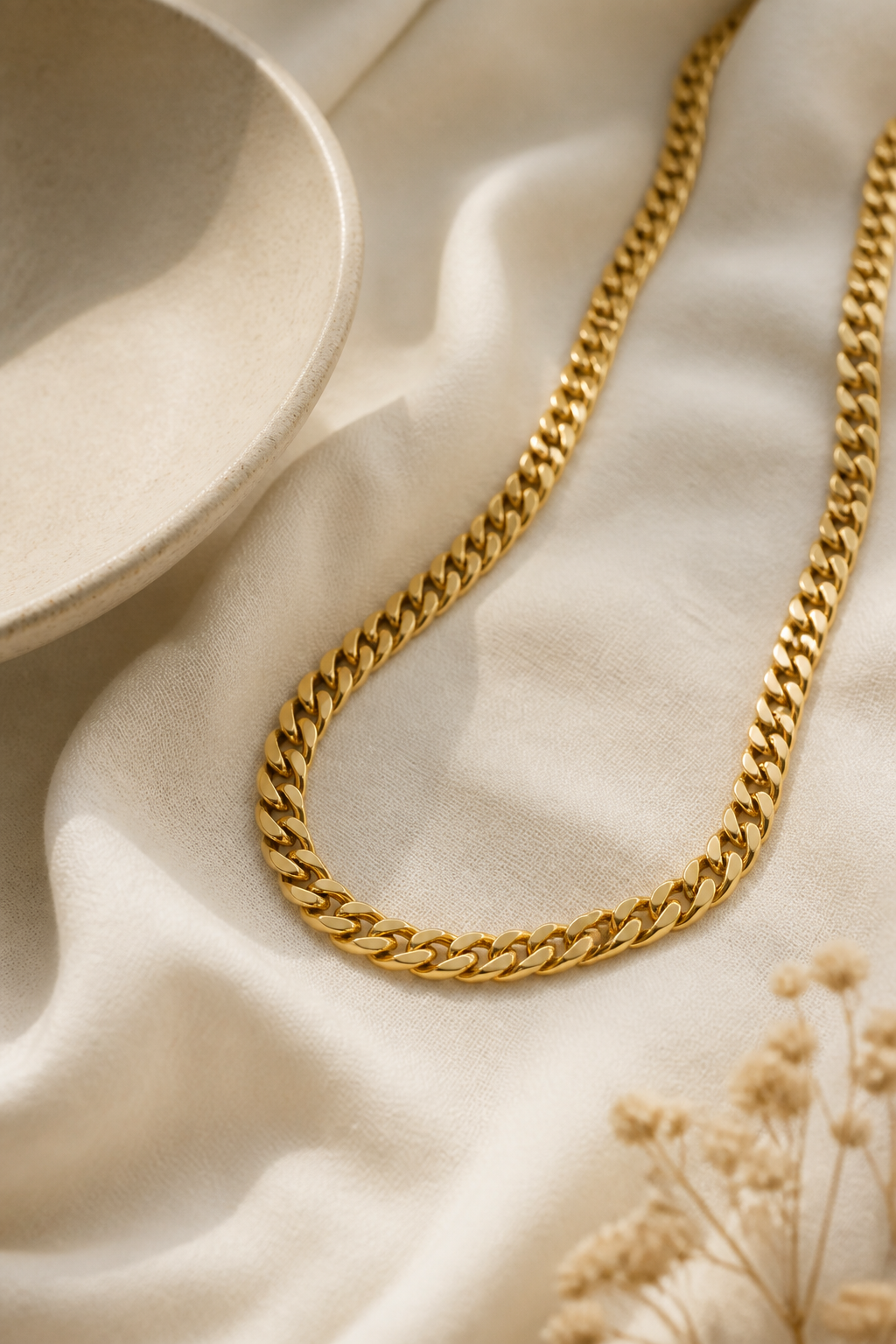
Ask most people what determines the price of a gold necklace and they will say the gold price. That is roughly a third of the answer.
A finished piece of jewellery has at least five separable costs, and a shop that is confident in its pricing will show you all of them. Here they are, in the order they get added.
1. The metal
Start with the international spot price for pure gold, quoted per troy ounce — 31.1035 grams. Divide to get a per-gram rate.
Then adjust for purity. Jewellery is rarely pure gold, because pure gold is too soft to hold a stone. 22K is 22 parts gold in 24, so 91.67% of the fine rate. 18K is 75%. 14K is 58.3%. This is the single biggest reason two pieces of identical weight can differ enormously in price, and it is why every honest product page states a purity.
2. Wastage
Making a 10g ring consumes more than 10g of metal. Some is lost as filings, some in the crucible. Two to five percent is normal depending on the complexity of the work.
Wastage is legitimate. Wastage of fifteen percent on a plain band is not — it is margin wearing a technical-sounding name. Ask what the figure is and what justifies it.
3. Making charges
The labour: casting, filing, setting, polishing. Charged either per gram or as a flat fee, and it varies hugely with difficulty. A plain band is quick. A piece with forty pavé stones takes a setter most of a day and the charge reflects that.
This is the number where craftsmanship actually shows up in the price, and it is the one most often hidden inside a single lump sum.
4. Stones
Valued separately from the metal, on the familiar four Cs, and priced non-linearly: a single one-carat diamond costs far more than four quarter-carat stones of the same grade, because large rough is rarer.
A seller should tell you carat, clarity, colour and cut for anything significant, and hand you a laboratory certificate above roughly half a carat.
5. Margin
The shop’s profit. It funds the showroom, the workshop, the insurance and the aftercare. There is nothing wrong with it — only with pretending it is not there.
Working it through
A 22K chain weighing 20g, with 3% wastage, at a fine gold rate of ₹12,000 per gram:
- Rate at 22K: ₹12,000 × 0.9167 = ₹11,000 per gram
- Gross weight: 20g × 1.03 = 20.6g
- Metal value: 20.6 × ₹11,000 = ₹226,600
- Making at ₹600/g: ₹12,000
- Subtotal: ₹238,600
- Margin at 12%: ₹28,632
- ₹267,232, before tax
Every one of those lines is checkable. That is the point.
What to ask
What is the net metal weight? What purity, and is it hallmarked? What wastage percentage, and why? What is the making charge? What are the stones and are they certified? What gold rate are you using today?
A jeweller who cannot answer those quickly is either disorganised or hoping you will not ask. Every piece on this site answers all six before you have to.
Leave a Reply